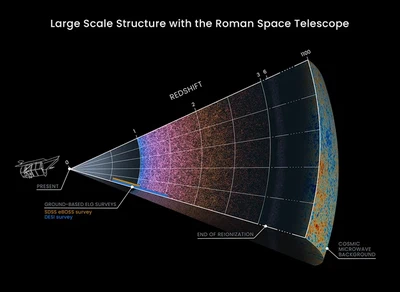
Roman Galaxy Redshift Survey
I am a member of the Roman Space Telescope’s Galaxy Redshift Survey (GRS) Project Infrastructure Team (PIT), where I lead the development of mock galaxy catalogues used as input …
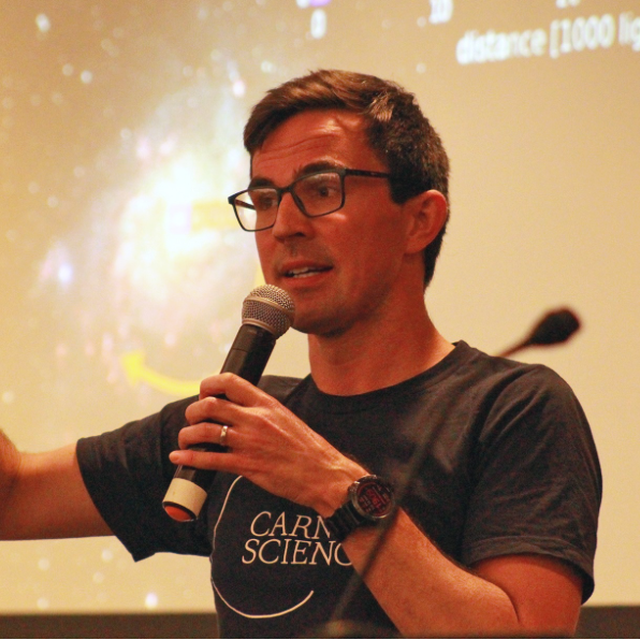
I am an astrophysicist interested in how the Universe forms and evolves, with a focus on dark matter and dark energy. Dark matter is an invisible form of matter that shapes the formation of galaxies through its gravity, while dark energy is the unknown component driving the accelerated expansion of the Universe.
My current work is part of NASA’s Roman Space Telescope project. I develop and improve models of galaxy formation, and use them to create large, realistic “synthetic skies” by simulating the formation of galaxies on supercomputers. These mock catalogues are used to test survey strategies for Roman’s Galaxy Redshift Survey and to develop and validate analysis methods before real data arrives.
More broadly, I am interested in the physics of the dark sector and how structure grows in the Universe over cosmic time. I have worked extensively on gravitational lensing—using the bending of light to probe dark matter—and continue to supervise and contribute to projects in this area, as well as on self-interacting dark matter. A central theme of my work is making sure that the conclusions we draw about the Universe are genuinely robust, by testing how our assumptions, models, and analysis methods can shape—or sometimes mislead—our interpretation of the data.
I am a member of the Roman Space Telescope’s Galaxy Redshift Survey (GRS) Project Infrastructure Team (PIT), where I lead the development of mock galaxy catalogues used as input …
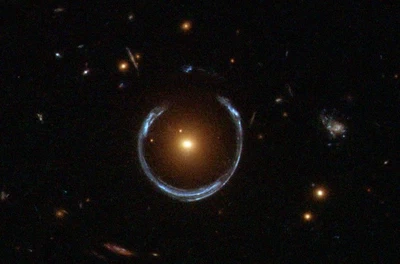
Using distorted images of distant galaxies to map mass and probe dark matter on small scales.
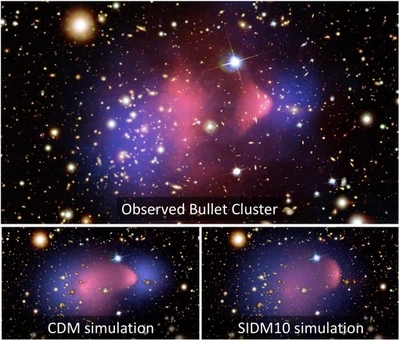
Using gravitational lensing and simulations to explore the small-scale behaviour of dark matter.
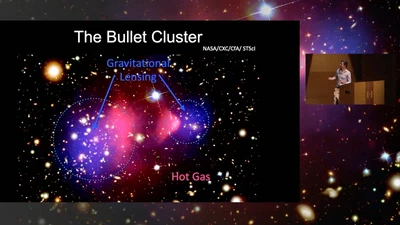
A public lecture on dark matter, and how galaxy cluster collisions can help reveal the nature of the unseen Universe.

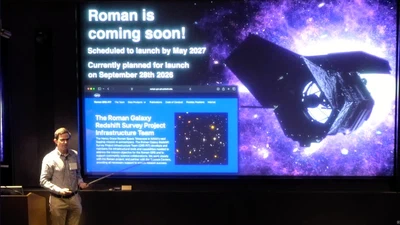
A method for rapidly calibrating semi-analytic galaxy formation models using stellar-to-halo mass relation constraints.
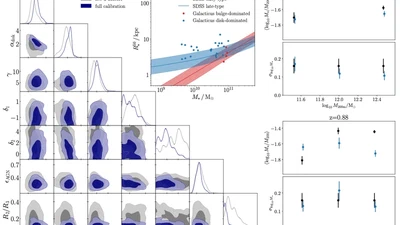
A fast likelihood framework for calibrating semi-analytic galaxy formation models using stellar-to-halo mass relation constraints, demonstrated with Galacticus.
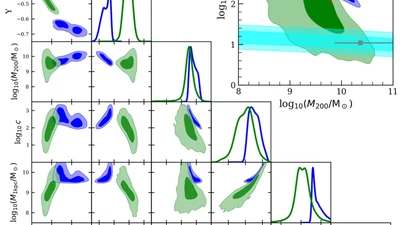
Reanalysis of the strong lens SDSS J0946+1006 showing that its apparent high-density subhalo can be naturally explained if the perturber hosts a faint satellite galaxy.