Not So Dark, Not So Dense: An Alternative Explanation for the Lensing Subhalo in SDSS J0946+1006

Oct 1, 2025·
Qiuhan He
Andrew Robertson
Andrew Robertson
,
James W. Nightingale
,
Aristeidis Amvrosiadis
,
Shaun Cole
,
Carlos S. Frenk
,
Samuel C. Lange
,
Shubo Li
,
Ran Li
,
Xiaoyue Cao
,
Leo W. H. Fung
,
Xianghao Ma
,
Richard Massey
,
Kaihao Wang
,
Maximilian Von Wietersheim-Kramsta
· 2 min read

New development: This system will be observed with JWST in Cycle 5 (Program 12088). The multi-wavelength imaging will help disentangle emission from the lensed source and any putative satellite galaxy, providing a decisive test of the interpretation presented here.

Strong gravitational lensing provides one of the most powerful ways to detect small clumps of dark matter in distant galaxies. By studying how these substructures perturb the shapes of lensed images, astronomers can measure the mass and density of otherwise invisible objects.

Previous analyses of the lens system SDSS J0946+1006 suggested the presence of a dark matter subhalo with an unusually high central density. Such an object would be difficult to reconcile with predictions from the standard cold dark matter model and attracted significant attention.

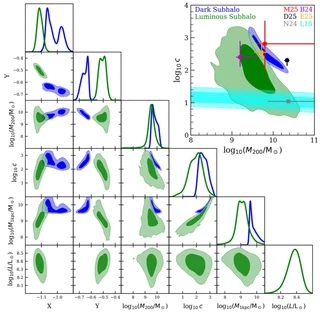
In this work we revisit the system and explore a different possibility: that the perturber may host a faint satellite galaxy. Once this possibility is included in the lens modelling, the data can be explained without requiring an extreme dark matter density.

While this provides a compelling alternative interpretation, it is currently difficult to determine conclusively whether the perturber contains a faint galaxy or is truly dark. Future observations at multiple wavelengths could help resolve this question: colour differences between the lensed background source and any satellite galaxy would allow the two components to be more cleanly separated, providing a stronger test of the model.
Abstract
Previous studies of the strong lens system SDSS J0946+1006 have reported a dark matter subhalo with an unusually high central density, potentially challenging the standard cold dark matter (CDM) paradigm. However, these analyses assumed the subhalo to be completely dark, neglecting the possibility that it may host a faint galaxy. In this work, we revisit the lensing analysis of SDSS J0946+1006, explicitly modelling the subhalo as a luminous satellite. Incorporating light from the perturber broadens the range of allowed subhalo properties, revealing solutions with significantly lower central densities that are consistent with CDM expectations. The inferred luminosity of the satellite also aligns with predictions from hydrodynamical simulations. While high-concentration subhaloes remain allowed, they are no longer statistically preferred. The luminous subhalo model yields a better fit to the data, while also offering a more plausible explanation that is in line with theoretical expectations. We validate our methodology using mock data, demonstrating that neglecting subhalo light can lead to inferred mass distributions that are artificially compact.
Type
Publication
The Astrophysical Journal Letters