Overview
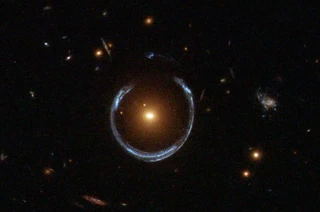
Strong gravitational lensing occurs when a massive object—such as a galaxy or cluster—bends light from a more distant source, producing multiple images, arcs, or even complete Einstein rings. Because gravity depends only on mass (not whether it is luminous or dark), lensing provides a direct way to map the distribution of dark matter.
It is also one of the most sensitive probes of small-scale structure: even low-mass subhaloes can leave detectable imprints in the detailed morphology of lensed images.
My work focuses on using strong lensing as a test of dark matter physics, while ensuring that the inferences drawn are robust to modelling assumptions and observational limitations.
Galaxy-scale strong lensing
Galaxy-scale lenses provide one of the cleanest ways to detect dark matter substructure. In these systems, small perturbations to lensed arcs or Einstein rings can reveal the presence of otherwise invisible subhaloes.
A handful of low-mass substurctures have now been detected using both optical imaging and VLBI (radio) observations. These measurements are often interpreted as constraints on the abundance and internal structure of dark matter subhaloes, and therefore on the nature of dark matter itself.
However, the interpretation is not always straightforward. A key focus of my work is testing how robust these inferences are using realistic mock datasets. By generating synthetic observations and analysing them with the same tools used on real data, we can assess when apparent detections genuinely require new dark matter physics.
Example: SDSS J0946+1006
The lens system SDSS J0946+1006 has been widely discussed as evidence for a very dense dark matter subhalo.
In recent work, we showed that the data can also be explained if the perturber hosts a faint galaxy. When this is included in the modelling, there is no need to invoke an unusually compact dark matter structure.
This system illustrates how sensitive lensing inferences can be to seemingly small modelling choices, and why careful validation is essential.
Cluster-scale strong lensing
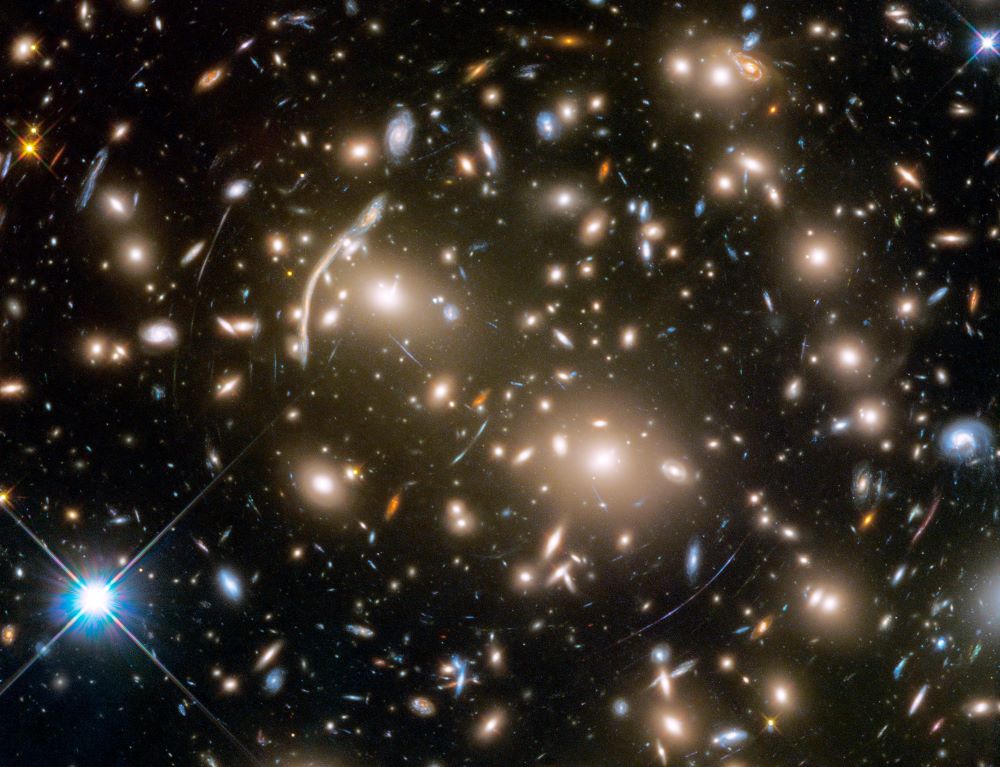
On larger scales, galaxy clusters produce complex networks of arcs and multiple images, allowing detailed reconstruction of their mass distributions.
Several studies have suggested potential discrepancies between observed cluster substructure and predictions from CDM simulations. These include claims of an excess of massive subhaloes or differences in their spatial distribution.
While these results are intriguing, their interpretation remains uncertain. In particular, comparisons between simulations and observations can be affected by selection effects, projection, and modelling assumptions. In this work, I argued that some reported tensions may be less significant than initially claimed.
Even so, cluster-scale lensing remains a promising avenue for testing dark matter models, particularly as both simulations and observational datasets improve.
Merging clusters
Merging clusters provide a complementary test of dark matter physics.
In these systems, the different components—stars (galaxies), gas, and dark matter—can become spatially separated during the merger. By comparing their relative distributions, it is possible to constrain properties such as the self-interaction cross-section of dark matter.
The Bullet Cluster is the most famous example, and has provided some of the strongest constraints on self-interacting dark matter.
I am currently involved in efforts to interpret new observations of merging clusters, including a recently-completed JWST programmes targeting the Bullet Cluster and a recently-accepted JWST proposal to observe the Planck Bullet. This work combines simulations and lensing analyses to understand how reliably we can extract constraints on dark matter physics from these systems.
